

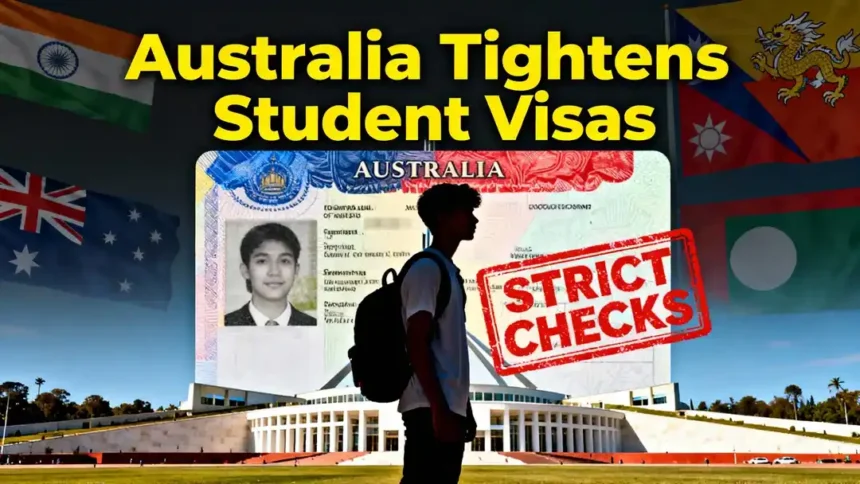
Australia student visa checks have tightened for applicants from India and several South Asian nations.
Australian and Indian media confirmed India’s move into the highest risk assessment category.
The decision places India alongside Nepal, Bangladesh, and Bhutan.
The Australian administration cited emerging integrity risks behind the revised classification.
Background to the Decision
The Times of India reported the reclassification occurred outside the usual review cycle.
No single official reason was publicly detailed for India’s new rating.
Reports of fake degree cases in India gained international media attention.
These reports reportedly influenced the Australia student visa checks process.
Almost 140,000 Indian students are part of Australia’s 650,000 international learners.
The four high-risk countries represent almost one-third of projected 2025 enrolments.
Impact on Prospective Students
Assessment levels affect documentation requirements and visa processing experiences.
Higher levels demand stronger proof of finances and English proficiency.
Applicants must also demonstrate genuine temporary entrant intentions.
Australia student visa checks at higher levels can increase processing times.
Costs may rise, creating concern among prospective international students.
Stakeholder groups stress clarity and predictability for major source countries.
India remains one of Australia’s largest international education markets.
Official Response and Oversight
Experts say genuine students still retain pathways to Australian education.
Authorities expect closer scrutiny of South Asian applications.
Officials from the Department of Education and Home Affairs will provide detailed guidance.
This guidance will explain documentation requirements and assessment changes.
Providers await confirmation on whether the measures are temporary.
Fraudulent Applications and Global Context
Authorities reported increased fraudulent academic and financial documentation.
These findings followed official visits to South Asia.
Australia’s International Education Minister Julian Hill addressed global competition pressures.
He described Australia as the least restrictive option among major study destinations.
Stronger Australia student visa checks aim to protect visa integrity.
Experts note students rejected elsewhere increasingly apply to Australia.
Phil Honeywood highlighted rising document fraud among such applicants.
Risk categorisation enhances filtering to ensure genuine study intentions.
Sector Concerns and Policy Clarity
Some education leaders question how risk levels are measured.
Sudden assessment changes affect recruitment planning and agent coordination.
Honeywood discussed timing concerns with Minister Hill directly.
He noted confusion during the first intake of the 2026 academic year.
Institutions require stability to support applicants effectively.
Clear policy signals help students navigate evolving visa rules with hope.
Countries in the Highest Risk Category
| Country | Assessment Level | Key Impact |
|---|---|---|
| India | Highest Risk | Increased scrutiny and documentation |
| Nepal | Highest Risk | Stricter financial verification |
| Bangladesh | Highest Risk | Enhanced application filtering |
| Bhutan | Highest Risk | Longer processing timelines |
Australia student visa checks remain central to balancing integrity and access.