

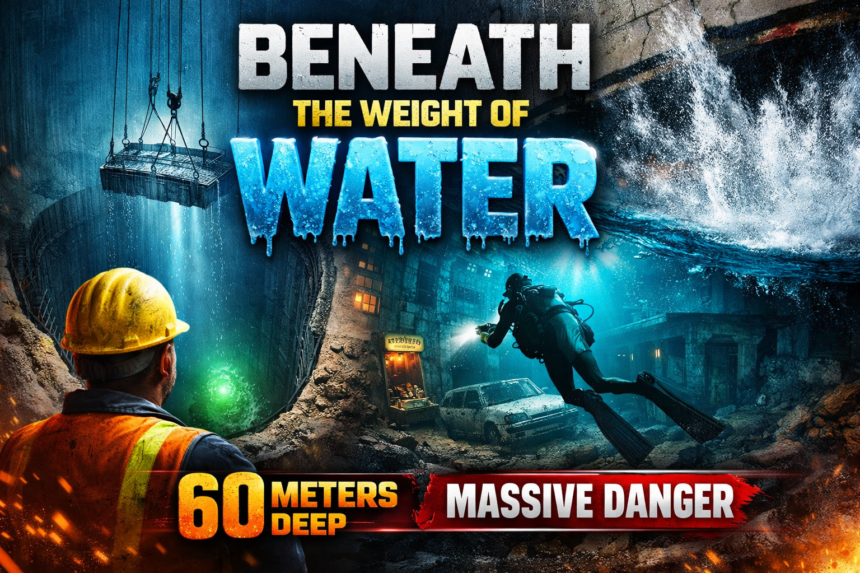
In a city that had already touched the sky, a different ambition began to take shape—one that would not rise, but descend into the earth. Dubai had become a symbol of the impossible, a place where records were not merely broken but redefined. Yet this time, the challenge was unlike any before. It would not glitter in sunlight or tower above the horizon. It would remain hidden, buried deep beneath the desert.
The idea was simple in words, but terrifying in execution: to build the deepest diving pool in the world.
It was not meant to be just a pool. It would be an experience—an entire submerged world, inspired by the ancient pearl divers who once plunged into the sea without equipment, chasing treasures hidden in shells. The structure itself would reflect that heritage, shaped like a giant oyster, as if the desert itself had opened to reveal something precious within.
But dreams, especially ambitious ones, demand sacrifice.
And this one demanded everything.
The first challenge was not depth, but direction.
Instead of building upward like a conventional structure, the engineers had to carve their vision downward. A massive vertical shaft had to be excavated—wide enough to hold a submerged city and deep enough to earn global recognition. The plan was to dig forty-five meters into the ground, forming the core of the structure.
The desert, however, is never as still as it seems.
Before excavation could even begin in full force, the engineers faced a critical question: how to prevent the earth from collapsing into the void they were about to create. Their solution was a technique known as a diaphragm wall—a concrete barrier built deep into the ground around the excavation site.
It was a slow and delicate process. Narrow trenches were dug, reinforced with steel cages, and filled with concrete in carefully measured sections. Piece by piece, a protective wall began to take shape, forming a circular boundary around the future pool.
It took months.
Only then could the real digging begin.
At first, everything went according to plan.
Machines roared as they tore through layers of sand and rock. The earth gave way reluctantly, but steadily. The shaft grew deeper with each passing day.
Then, at a depth of just eight meters, something unexpected happened.
Water.
It seeped through the tiny gaps in the diaphragm wall, almost unnoticed at first. But within hours, the trickle became a steady flow. Soon, the bottom of the excavation was covered in water, turning solid ground into unstable mud.
The engineers knew they had encountered groundwater—a force that could not be ignored.
To continue, they installed massive pumps to remove the water as quickly as it entered. Day and night, the pumps worked without pause, fighting an invisible enemy that refused to retreat.
What was expected to be a temporary measure turned into a long-term battle.
For two years, the pumps never stopped.
The excavation continued under relentless pressure—both mechanical and mental. Thousands of tons of earth were removed, layer by layer. Dust filled the air, machines groaned, and the workers pressed on, driven by a vision that refused to fade.
By the time the shaft reached its planned depth of forty-five meters, the team had already endured more than most projects demanded.
But the real test was yet to come.
The news arrived without warning.
A diving pool in Poland had officially opened—and its depth was exactly forty-five meters.
For a moment, disbelief filled the room.
Years of work, all aimed at achieving a world record, suddenly seemed meaningless. They had reached their goal… only to discover someone else had arrived there first.
Silence followed.
Then came the decision.
They would go deeper.
Extending the depth from forty-five to sixty meters seemed like a straightforward solution. But the engineers knew better. Beneath the surface, unseen forces were waiting.
At that depth, groundwater pressure would become dangerously powerful. The empty structure, buried below the water table, would face an upward force known as buoyancy—the same force that causes objects to float.
The deeper the pool, the stronger the force.
Calculations revealed a frightening possibility: if extended without proper modifications, the entire structure could be pushed upward by the pressure beneath it. It could rise out of the ground like a cork forced out of water.
The project stood at the edge of failure.
Work came to a halt.
For days, the site was filled with tension. Engineers debated, recalculated, and searched for a solution that could defy both physics and time.
Finally, an idea emerged.
Not one solution—but two, working together.
First, they decided to reduce the diameter of the additional fifteen meters. By making the lower section narrower, they could reduce the surface area exposed to upward pressure, thereby decreasing the force acting against the structure.
But this alone was not enough.
The second solution was far more critical.
They would anchor the structure to the earth itself.
Using a technique known as an under-reamed base, the engineers designed a foundation that extended outward beneath the pool, gripping the surrounding soil like an anchor holding a ship in place. This would counteract the buoyant force, ensuring the structure remained firmly grounded.
It was a bold move.
A necessary one.
Construction resumed with renewed intensity.
Every step was calculated. Every decision carried weight. The margin for error had vanished.
Slowly, the excavation reached sixty meters.
The structure held.
But another danger loomed.
The pool could not remain empty for long.
Without the counteracting weight of water inside it, the upward pressure from below could still destabilize the structure. Time was no longer a luxury—it was a threat.
Filling the pool became the next urgent mission.
The volume required was immense—millions of liters of water. The local supply system could not deliver it fast enough. At its normal capacity, it would take months to fill the pool.
That was time they did not have.
So they turned to an extraordinary solution.
More than a hundred water tankers were brought in, working alongside the city’s water supply. Day and night, they poured water into the vast, empty structure.
Even with such effort, it took an entire month.
Before the final filling, the interior had already been transformed.
What once was an empty shaft had become a submerged city. Rooms, corridors, abandoned objects—each element carefully placed to create an illusion of life frozen in time.
But water changes everything.
Some materials began to corrode. Others floated unexpectedly, disrupting the carefully crafted environment. The team had to adjust, adding weight, modifying structures, and ensuring stability within the water.
Every detail mattered.
At last, the project was complete.
The deepest diving pool in the world stood hidden beneath the desert, holding millions of liters of water and an entire world within its depths.
From above, it appeared calm. Silent.
But beneath the surface lay years of struggle, moments of doubt, and solutions born from desperation.
It was more than an engineering achievement.
It was a battle—against nature, against time, and against the limits of human imagination.
And in the end, the greatest mystery remained not how it was built…
…but how close it came to never existing at all.