
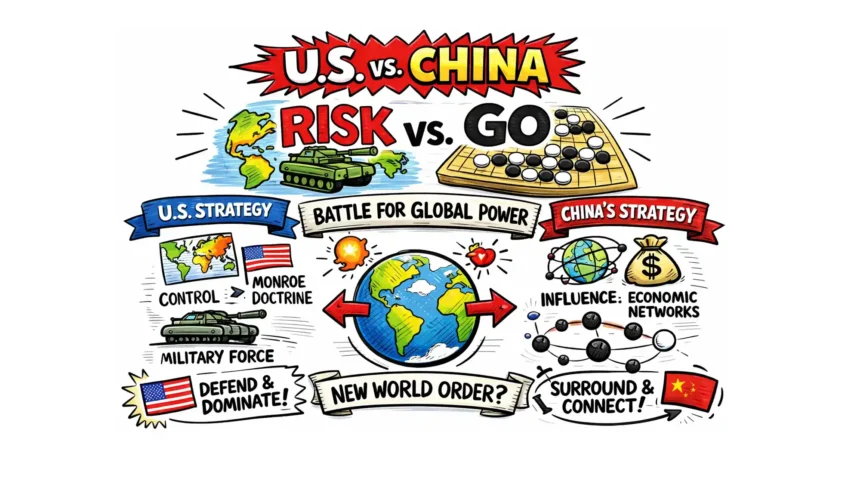
These strategies can be understood using the board games Risk and Go. Each game reflects how power is gained, defended, and expanded. Both nations are playing on the same global board. However, they are following different rules.
The United States and the Logic of Risk
Risk is a game about controlling territory and defending empires. It rewards domination, elimination, and clear boundaries. The United States behaves in a similar strategic manner.
American strategy focuses on defending its home territory first. It also prioritizes removing rivals near its sphere of influence. This approach reflects the mindset of a declining but powerful empire.
Defending the Western Hemisphere
For the United States, the Western Hemisphere remains a red line. This belief originates from the 1823 Monroe Doctrine. Any foreign intervention in this region is seen as unacceptable.
The modern version is sometimes called the “Donroe Doctrine.” It reinforces exclusive American influence over the hemisphere. This explains many recent U.S. actions.
Venezuela and Strategic Containment
Venezuela plays a key role in this rivalry. U.S. actions there were not driven by democracy promotion. They were also not focused on drug control.
The real concern was China’s growing economic presence. China provided loans repaid through oil exports. This created long-term leverage inside the American sphere.
By targeting President Maduro, the United States aimed to disrupt those energy deals. Washington also sought control over Caribbean and Atlantic energy flows. The move sent a clear message to Beijing. The Western Hemisphere remains exclusively American territory.
Greenland and Future Power
Greenland is critical to future U.S. strategy. Melting Arctic ice is transforming global trade routes. It is also unlocking valuable rare earth minerals.
The United States views Greenland as a strategic gateway. It could become a powerful corner for rivals. Washington wants to prevent that outcome.
The U.S. blocks Chinese infrastructure projects there. It also works to exclude China from Arctic governance. Public security claims reinforce American ownership over the territory.
Iran and Disrupting Connections
Iran is another major pressure point. The United States does not seek to conquer Iran. Instead, it seeks to break strategic connections.
Iran sits at a crucial intersection of Chinese influence. Multiple trade and transit lines converge there. This makes Iran vital to China’s global strategy.
By threatening war, the United States aims to sever these links. This would weaken China’s ability to bypass maritime containment. It would also disrupt alternative global trade routes.
China and the Logic of Go
Go is a game of influence rather than elimination. It rewards patience, positioning, and network building. China’s strategy closely mirrors this philosophy.
Beijing avoids direct military confrontation with the United States. Instead, it shapes influence gradually. Economic ties replace military bases.
Long-term positioning matters more than immediate victories. China aims to surround rather than strike directly.
Venezuela as Economic Entry
In Venezuela, China pursued influence through finance. Loans were repaid in oil shipments. This secured a major energy supplier.
It also established economic presence within the U.S. hemisphere. This challenged American dominance without military force. The move represented a classic Go strategy.
Greenland as a Strategic Corner
China views Greenland as a “corner” position. In Go, corners require minimal resources to control. They also offer long-term strategic value.
China’s interest is not military. It focuses on Arctic supply chains and future trade routes. Infrastructure projects support this vision.
The goal is integration into the Arctic economy. China seeks influence, not occupation.
Iran as a Critical Connector
Iran is central to China’s global ambitions. It anchors China’s westward expansion. It links Central Asia, the Middle East, and Europe.
This connection supports the Belt and Road Initiative. It helps China bypass U.S. naval dominance. It also supports sanctions-resistant trade systems.
China can move goods and money without the U.S. dollar. This reduces reliance on American financial control.
A Shifting World Order
Venezuela, Greenland, and Iran are not isolated crises. They are pressure points in a changing global system. Each represents a strategic clash.
The United States seeks to preserve a unipolar order. That order relies on military power and financial coercion. China promotes a multipolar system.
Its model is built on trade and infrastructure. Economic networks replace direct force.
History shows how world orders change. They collapse when power is broken. They fall when connections are cut.
These moments often follow confrontation. The current phase represents the opening moves. A new global board is taking shape.
The future will depend on one question.
Will influence prevail, or will force decide?