

The global conditions that enabled China’s success no longer exist.This article explains why China’s development path cannot be copied today.It also explores what this means for developing economies worldwide.
- China’s Unprecedented Economic Transformation
- The Key Pillars Behind China’s Rise
- Demographic Advantage
- The Era of Hyper-Globalization
- State Policy and Infrastructure Investment
- Supply Chain Clustering
- Why the Development Ladder Is Now Broken
- The End of Cheap Labor
- Deglobalization and Protectionism
- Automation and Robotics
- Premature De-industrialization
- Global Consequences of the Broken Ladder
- Mexico’s Productivity Paradox
- India’s Manufacturing Challenge
- China’s Own Middle-Income Trap
- Diversification Without Replacement
- Rethinking the Development Model
- New Paths Toward Sustainable Prosperity
China’s Unprecedented Economic Transformation
China moved from poverty to industrial dominance within a single generation.
It transitioned from an agrarian society to a global manufacturing powerhouse.
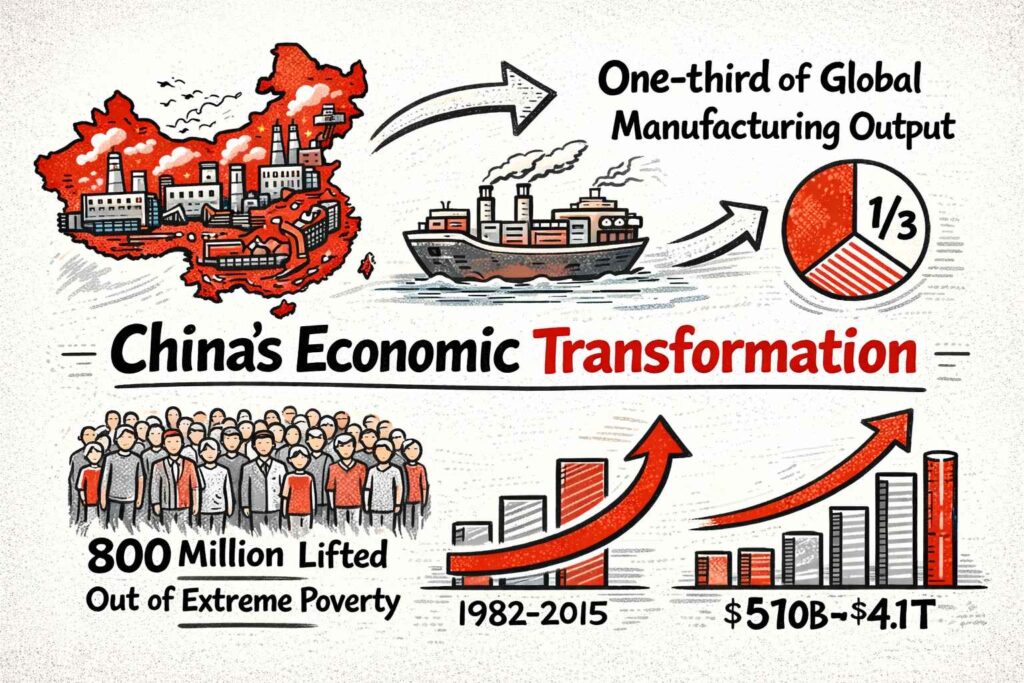
Over 800 million people escaped extreme poverty during this transformation.
This represents a historic achievement unmatched by any other nation.
China now produces nearly one-third of global manufactured goods.
These products range from consumer electronics to heavy industrial materials.
After joining the World Trade Organization in 2001, exports surged rapidly.
Total trade rose from $510 billion to $4.1 trillion by 2017.
By 2023, China accounted for 31–32 percent of global manufacturing output.
This scale has never been achieved before by one country.
The Key Pillars Behind China’s Rise
Demographic Advantage
China benefited from a massive labor surplus for decades.
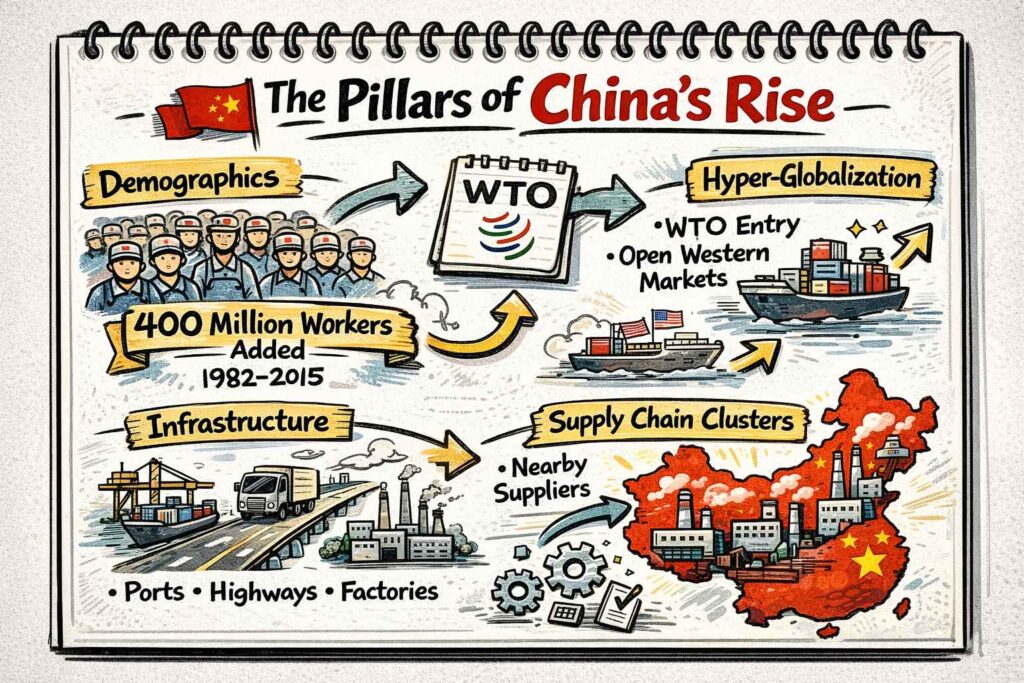
Between 1982 and 2015, 400 million workers entered the labor force.
Wages remained low, while literacy rates stayed high.
This combination created cheap, capable, and disciplined factory labor.
The Era of Hyper-Globalization
China’s rise aligned with peak global openness.
Trade barriers fell across Western economies.
After WTO entry, tariffs on Chinese goods stayed minimal.
Exports grew at nearly 30 percent annually between 2001 and 2006.
Western markets absorbed enormous volumes of Chinese products.
This demand fueled rapid industrial scaling.
State Policy and Infrastructure Investment
The Chinese government prioritized manufacturing as a national strategy.
Special economic zones attracted foreign capital and expertise.
Massive investments built highways, ports, power plants, and rail networks.
Factories operated at unprecedented speed and scale.
This infrastructure reduced costs and improved reliability.
Supply Chain Clustering
China developed dense supplier ecosystems within close geographic areas.
Factories sourced components within hours instead of weeks.
Costs dropped sharply, while production speed increased.
China became a one-stop manufacturing destination.
Competing locations struggled to match this efficiency.
Why the Development Ladder Is Now Broken
The End of Cheap Labor
China reached the Lewis turning point.
Surplus rural labor ran out.
Between 2005 and 2016, manufacturing wages tripled.
Wages exceeded levels in Mexico and Brazil.
Low-cost labor advantages disappeared.
Deglobalization and Protectionism
Political attitudes shifted in Western economies.
Globalization lost public support.
In 2018, the US imposed tariffs during a trade war.
China’s export price advantage weakened significantly.
Western governments grew cautious about supply chain dependence.
Automation and Robotics
Industrial robots became cheaper and more capable.
Automation reduced reliance on human labor.
Labor cost advantages now matter far less.
Factories no longer absorb millions of workers.
Premature De-industrialization
Many developing nations lost manufacturing jobs early.
This occurred before achieving high income levels.
The main engine of economic convergence slowed sharply.
Global Consequences of the Broken Ladder
Manufacturing growth stalled across much of the developing world.
In parts of Latin America and Africa, industry is shrinking.
Mexico’s Productivity Paradox
Mexico benefits from proximity to the United States.
It also gained access through NAFTA.
Yet manufacturing remained an isolated enclave.
Broader population gains remained limited.
Many workers shifted into low-wage service jobs.
India’s Manufacturing Challenge
India launched initiatives like “Make in India.”
However, manufacturing’s GDP share stagnated.
Infrastructure gaps and regulatory challenges persist.
Automation intensified global competition.
China’s Own Middle-Income Trap
China faces slowing growth and rising costs.
An aging population adds further pressure.
Geopolitical tensions complicate trade relationships.
Reaching high-income status is increasingly difficult.
Diversification Without Replacement
Global supply chains are diversifying.
Strategies like “China plus one” are expanding.
Countries like Vietnam and Bangladesh gained limited shares.
None can fully replace China’s scale.
Rethinking the Development Model
Traditional export-led industrialization has narrowed.
Automation limits job creation in factories.
Many nations risk stagnation in agriculture or informal services.
New Paths Toward Sustainable Prosperity
Investment, Infusion, and Innovation
Countries must invest in infrastructure and education.
They should adopt technology from advanced economies.
Eventually, innovation must drive long-term growth.
Increasing Labor Value
Cheap labor alone no longer works.
Technical education and vocational training are essential.
Skilled workers improve productivity and quality.
Strengthening Domestic and Regional Markets
Growth should serve domestic consumers first.
Regional trade can stabilize demand.
This reduces dependence on unpredictable Western markets.
Rethinking Social Policies
Governments may need active labor support.
Public works programs can stabilize employment.
Income support may prevent social instability.
A Complex but Possible Path
Development remains possible but more complex.
Manufacturing, services, and innovation must coexist.
Countries must invest in people and technology.
They must also manage climate and geopolitical risks.
China’s economic miracle was historically unique.
Its development ladder no longer exists.
Future growth requires new strategies, not imitation.
Success will depend on adaptability, investment, and innovation.